
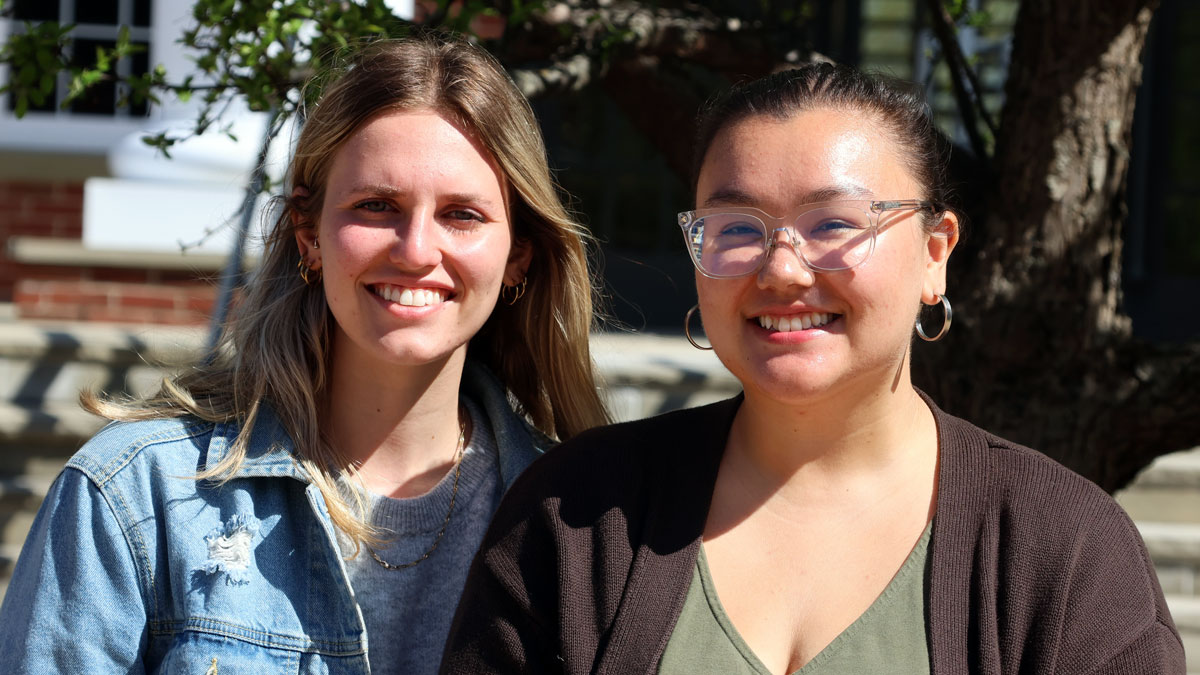
Ashley Langley (left) and Yossaria Yoon-Vickerman
As a member of the Atlantic Council for International Cooperation (ACIC), Coady Institute has supported the International Youth Internship Program (IYIP) by facilitating connections between ACIC and partner organizations of the Engage: Women’s Empowerment and Active Citizenship project. Through this collaboration, Coady partner Christian Commission for Development in Bangladesh (CCDB) hosted two Canadian interns, Yossaria Yoon-Vickerman and Ashley Langley.
Internship placements are typically four months, providing young Canadians with hands-on international development experience while encouraging cross-cultural learning, leadership, and civic engagement.
Yossaria and Ashley recently completed their IYIP placements with CCDB where they engaged with the organization’s climate-related programming through a mix of field visits and observational learning. Yossaria has a background in international development and sustainability. Ashley has a background in aquatic resources and earth sciences. Both interns were drawn to the opportunity to apply their knowledge in a real-world setting.
“Working in climate change, especially in a hands-on-way, aligned with both of those paths,” Yossaria shares.
“The Climate Centre at CCDB, which models mitigation and adaptation tools, really spoke to my interests,” Ashley adds.
While the placements aligned well on paper, the reality proved more complex for the pair.
“I expected to be more involved in program work,” Yossaria says. “Instead, I often felt I wasn’t as integrated as I thought I’d be.”
Still, both interns emphasized that the experience held value, even when it diverged from expectations.
“I definitely made an impact, just not in the obvious way I had imagined,” Ashley says.
Each day brought something new, from travelling across Dhaka and Gazipur to unplanned field visits.
“We had no idea what each day would bring,” Ashley says. “But we showed up anyway, ready for whatever came.”
When asked about the most rewarding part of their placements, both interns pointed to the relationships they formed and the personal insight they gained.
“That’s what I’ll remember,” Yossaria says. “We’ve finished the internship, but I hope those connections last.”
Ashley echoed the sentiment and added that the experience deepened her awareness.
“It changed my perspective,” Ashley says. “I became more grateful for the systems I live in, the security I have, and the things I did not even think about before.”
Although the experience did not always unfold as expected, both found meaning in the process.
“You’re faced with so many changes at once, and you have to adapt quickly,” Yossaria says. “That kind of learning stays with you.”
Ashley also adds, “whether or not things went according to plan, everything we faced gave me transferable skills. I have learned I can take risks and handle them.”
Furthermore, the internship also challenged their ideas about development.
“You come in thinking you know the answers,” Ashley says. “But it’s not that simple.
She reflected on fast fashion, for example, noting that in Canada, we talk about ending it. In Bangladesh, the garment industry is a core part of the economy.
For Yossaria, the experience clarified some questions while raising others.
“There are so many ways to fit into this work,” she says. “And you can be a positive or a negative influence.”
Finally reflecting on cross-cultural collaboration, both spoke candidly about power and privilege.
“Even as interns, we were put on a pedestal,” Yossaria says.
The pair’s advice to future IYIP interns is to “hold on to the little moments. They remind you why you are there.”
For both interns, the value of the experience was not in how predictable it was, but in how it stretched them. What they took home was not just knowledge, but a new way of seeing. Although it was imperfect, the experience gave them what they did not know they needed: growth, challenge, and learning to carry complexity with care.