
In May 2025, nearly one hundred students and practitioners of adult education gathered at Coady Institute, St. Francis Xavier University for the Canadian Association for the Study of Adult Education (CASAE) Atlantic Regional Conference, Learning with Community. Participants came from universities, public sector departments, community organizations, and post-secondary programs across Atlantic Canada and Ontario.
Among them were six Fellows from Coady Institute’s Engage project – researchers, program managers, and a senior leader from partner organizations in Bangladesh, India, and Tanzania. The conference opened with a People’s School, providing local and global participants an opportunity to share ideas and experiences while exploring the theme of ‘learning with community’. Coady Institute’s Research Officer Ibtesum Afrin hosted a panel with four of the Fellows titled ‘Walking the Talk’ in which the panelists shared their experiences working alongside vulnerable communities in Bangladesh, India, and Tanzania supporting women’s empowerment and active citizenship.
When you go to communities, you have to be conscious that they understand their context better than you do. You are there to learn, to unlearn, and to co-create with them. It is the community members who assess their situation, analyze the root causes, and design the actions. That is how learning with community brings transformation.
Their participation brought global experience directly into a Canadian learning space, creating a rare opportunity for exchange between people working on the front lines of gender equality, climate resilience, and community-led development, and those shaping policy, research, and education in Canada. As Lilian Liundi from the Tanzania Gender Networking Programme shared, “when you go to communities, you are there to learn, to unlearn, and to co-create with them”.
During the panel, Fellows described how community-led approaches translate into tangible change. In Tanzania, women worked with local leaders to address barriers to girls’ education – building safe spaces in schools and successfully advocating for public budgets to supply menstrual products. In India, women in the informal economy collectively adopted solar-powered technologies reducing costs, improving livelihoods, and training women as clean-energy technicians. In coastal Bangladesh, communities living with frequent cyclones demonstrated deep expertise in climate adaptation. Ramzan Ali from the Christian Commission for Development Bangladesh said it’s important to remind researchers and practitioners that “people living with climate disasters know how to face them.”
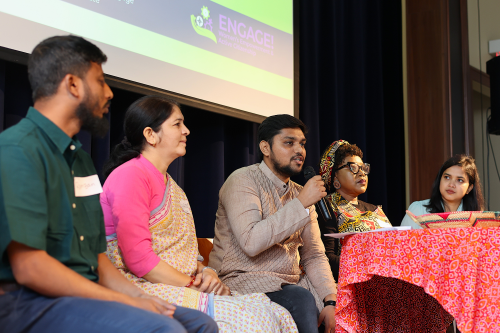
Panelists: Ramzan Ali, Bhavini Mehta, Brayan Macwan, Lilian Liundi, Ibtesum Afrin (moderator)
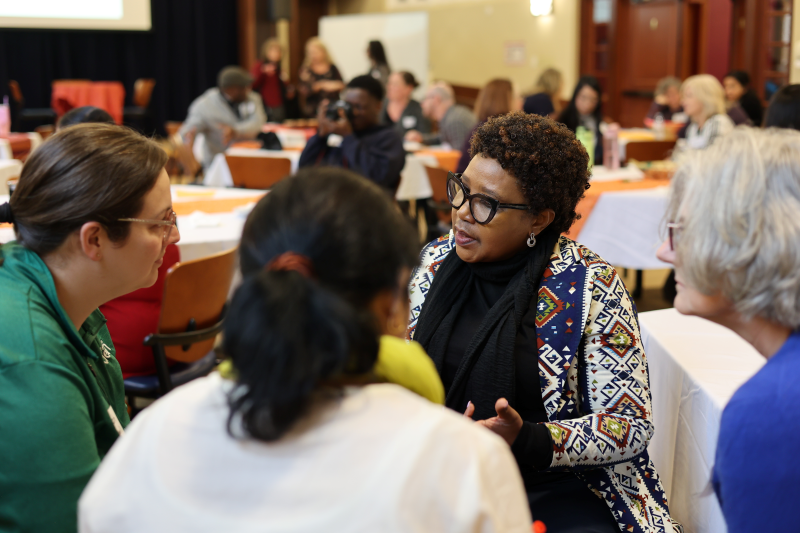
Lilian Liundi and attendees of the CASAE conference People’s School.
Engage supports this work at multiple levels. It strengthens grassroots initiatives while also investing in organizational capacity so partner organizations can sustain and expand their impact. As Brayan Macwan from the Self Employed Women’s Association in India reflected, “one person alone cannot achieve anything. It takes the togetherness of the whole community.”
These exchanges show why international development matters to Canadians. By investing in long-term partnerships and education, investments in international development strengthens community-based services abroad while enriching learning, research, and public dialogue here at home – building more connected, informed, and resilient societies, locally and globally.
Engage: Women’s Empowerment and Active Citizenship is a 6.5 year initiative co-designed by Coady Institute and five partner organizations in India, Ethiopia, Tanzania, Bangladesh, and Haiti. Coady is a convenor and is bringing these partners together in ways that they can share their expertise, learn from each other, and collectively explore new approaches and tools.
The project works primarily to support the leadership capacity of informal sector women in addressing key issues they are facing. This includes the future of work faced by women; engaging women in community governance; women’s leadership and feminist approaches, young women as entrepreneurs and agents of community change; and asset-based approaches to reducing urban and rural poverty through economic development.
Engage is funded by Global Affairs Canada.