Eileen Alma, Executive Director, Coady Institute
We are working in a world of “poly-crises”- overlapping shocks at global and local levels that amplify one another and unsettle our assumptions. Ruptures of all kinds are visible: some hopeful and regenerative, others harmful and corrosive. Youth are both the barometer and the engine of this moment. They navigate a public sphere crowded by proliferating ideologies and identity claims that can deepen division or forge unexpected solidarity.
At the same time, powerful forces push against equity, justice, humanity, and morality. Too often, narrowly defined, interest based economies and a return to nationalistic paradigms entrench “us versus them,” while the pendulum on human rights and gender equality never seems to rest—struggling against a deliberately crafted discourse that seeks to perpetuate imbalances of power.
Insecurity is becoming normalized for too many communities, where staying alive replaces the space to thrive. The callousness with which various leaders treat people and the Earth’s gifts begs the question: are we not better than this? Must power and ego be the organizing principles of our future? Amid it all, we must keep asking, what does a full and abundant life for all look like – and how do we prepare for it?
 At Coady Institute, the possibility of the world moving in multiple directions demands adaptive learning that meets the daily urgencies of societies. We have been here before. While we have evolved, our foundation beginning with the Antigonish Movement offers vital lessons of how a small place rose to meet the critical challenges of its time, shared its knowledge, and helped others do the same.
Today’s work requires critical conversation about what development is, the practices it privileges, and the ideologies it reproduces. We must draw on community-driven knowledge that genuinely contributes to democratic processes – knowledge that is accountable to people, not just to institutions.
Artificial intelligence is both a disruptive force and a connector, widening access while accelerating the spread of contradictory worldviews. Meanwhile, disillusionment with international institutions grows and funding ecosystems are stretched thin. What is left of “foreign aid” still moves from poor people in rich countries to rich people in poor countries. We need reliable information for an informed public; if we speak only to ourselves, we leave room for youth to be courted by right wing populism. As Italian philosopher Antonio Gramsci would have described it, we live in an interregnum: the old order is fading, the new has not yet formed, and uncertainty coexists with immense possibility.
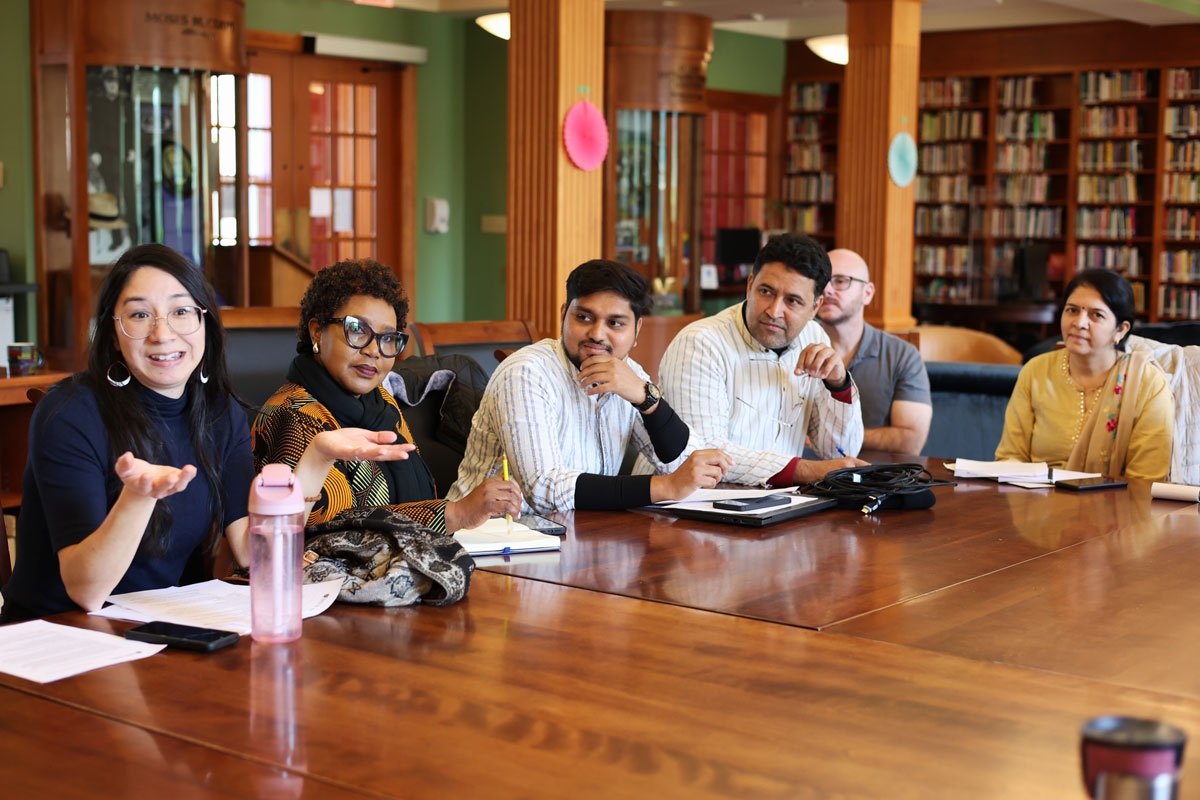 Community engagement gives me hope. Communities remind us that governments cannot do everything; civil society’s role is irreplaceable, and change begins at home. Education matters and endures. Technical capacity is important but even more critical are people’s determination, resilience, time management, adaptation, and local knowledge. Indigenous peoples are taking rightful places across political, social, and economic spaces, offering models of leadership that show how it should be done. Activists demanding accountability continue to show their bravery and welcome inter-generational collaboration. Coady Institute may have had a small hand on the learning journey, but their agency and determination lead the way. And there is the everyday generosity of people: big and small acts, and kind words that sustain our collective courage and create joy.
Our task, then, is to co-create educational offerings and provide choice with integrity: to orient toward abundance for all and stand with communities. Collectively, we will keep learning and move decisively from contention and competition to construction and collaboration, from interregnum to renewal.