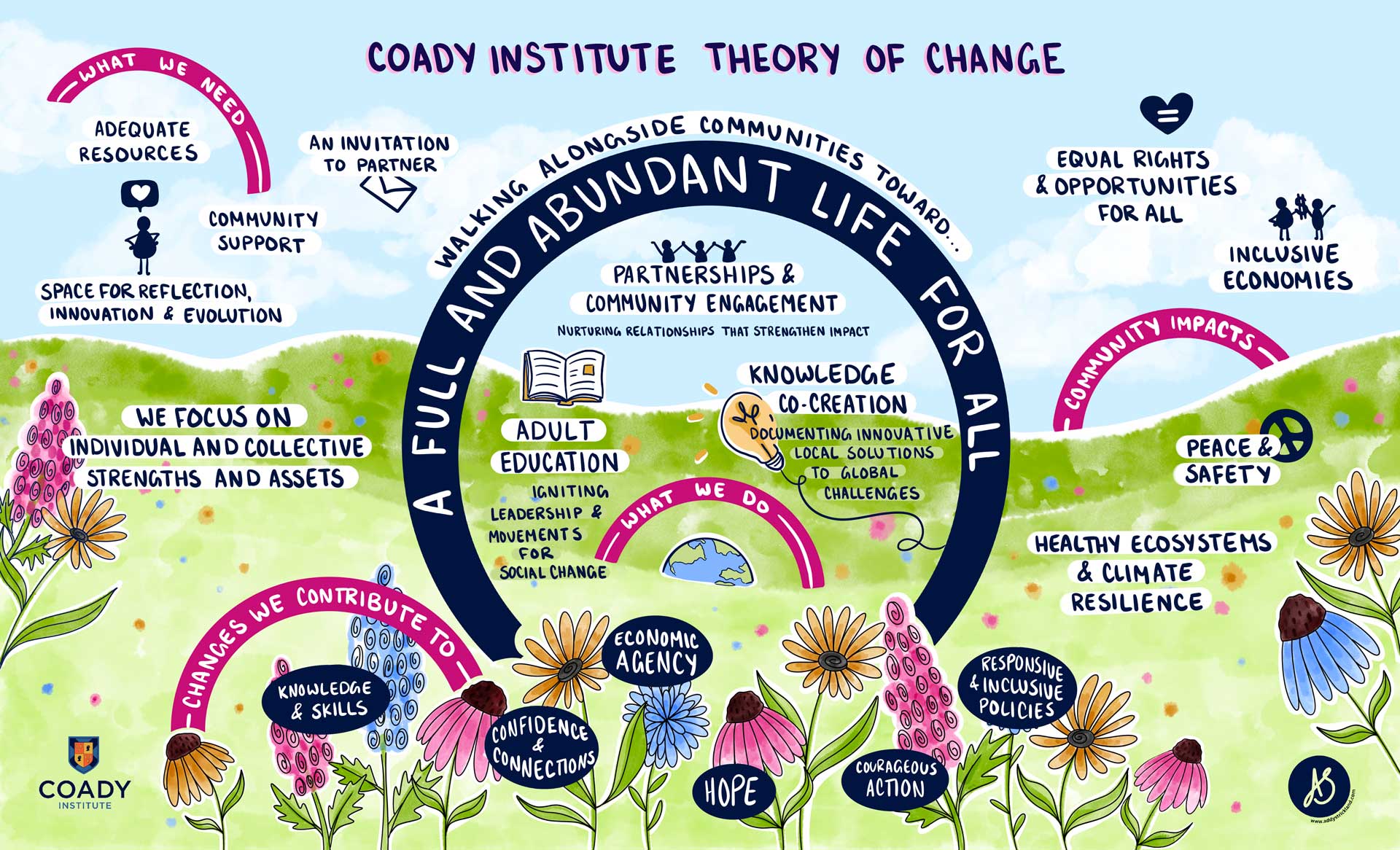
Coady Institute grew out of the conviction that communities must be the leaders of their own transformation. This belief continues to guide us today as we support communities in Atlantic Canada, across the country, and around the globe to create a “full and abundant life for all.” We are also committed to centering the leadership, knowledge, and lived experience of groups who are marginalized by systems of structural oppression, including Indigenous communities, Black and racialized people, and women and gender diverse people.
Our History
Coady Institute is located in Mi’kma’ki, the ancestral and unceded territory of the Mi’kmaq People, on the campus of St. Francis Xavier University in Antigonish, Nova Scotia.
Inspired by the Antigonish Movement’s vision of economic and social justice, Coady’s roots trace to StFX’s Extension Department, established in 1928. Our namesake Father Moses Coady summed up the Movement through this quote: “They will use what they have to secure what they have not.”
Working with communities across Atlantic Canada, the Extension Department advanced adult education, cooperative development, and citizen-led action. Building on this foundation, StFX established Coady International Institute in 1959 to share these approaches with communities around the world. In 2021, Coady International Institute and StFX’s Extension Department merged to form the Coady Institute which works both close to home in Atlantic Canada, across the country, and internationally.
Coady Institute is proud and grateful to actively engage with our global network of more than 11,000 changemakers in over 150 countries who have gone on to influence millions of others through asset-based community development (ABCD) approaches.

OUR ENDURING VISION
Communities create a “full and abundant life for all.”
OUR MISSION
We support and collaborate with community leaders, organizations, and allies through adult education, co-learning and knowledge exchange, promotion of transformative leadership, and support for collective visions of change.

ADDRESSING CHALLENGES:
The communities we partner with are addressing pressing and interrelated challenges, including:
- Loss of local decision-making power
- Discrimination, inequality, and erosion of human rights
- Poverty
- Division and violence
- Ecosystems collapse and climate change
COMMUNITY IMPACTS
The broader changes that communities are working towards include:
- Collective agency and accountable public institutions
- Equal rights and opportunities
- Inclusive economies
- Peace, security, and justice
- Healthy ecosystems and climate resilience
What we do
We continue to evolve our approach to transformative and community-led learning in ways that both reflect our longstanding foundations in the Antigonish Movement and respond to the urgent social, environmental, and political challenges facing communities today. Education is understood as a catalyst for critical reflection, leadership, justice, equity, reconciliation, and community self-determination.
Adult Education
We facilitate transformation through participatory learning ecosystems for community development practitioners that include courses, workshops, mentorships, group forums, accompaniment, and resource sharing. We also take advantage of the fact that we are situated within a university to engage StFX students in transformative learning opportunities, including internships and fellowships, with the hope of inspiring a new generation of asset-based community development leaders in Canada.
Knowledge Co-creation
Partnerships and community engagement
How we work
Our work is grounded in the abundance of strengths and gifts of individuals and within communities, using an asset-based community-development approach.
Our work is rooted in the values of respect, relevance, reciprocity, responsibility, and relationships which we draw from Indigenous scholarship and teachings. We work alongside communities and partners as learning companions, facilitators, and connectors, rather than as external experts delivering predetermined solutions. We are open to diverse ways of thinking, being, and doing.
Our work is context-specific and circular, recognizing that there are no universal solutions, and that change rarely follows a linear path. We support communities to build collective power and develop community-owned responses to the issues that matter most to them. We increase the accessibility and relevance of our educational offerings by co-developing them with community partners, providing multiple entry points and opportunities for participants to deepen engagement over time, and reducing barriers related to cost, travel and geography.
We use systems-oriented thinking to connect issues that are too often treated as separate struggles—including economic, climate, gender, and racial justice—and to understand and strengthen the relationships between people, institutions, communities, and ecosystems.
What we need in order to do this work well together
Our ability to do this work depends on an invitation to partner, adequate resources, community support, and space for collective reflection, innovation, and evolution. These conditions allow us to remain responsive to communities, nurture reciprocal relationships, learn together, and adapt our approaches as contexts and aspirations change.