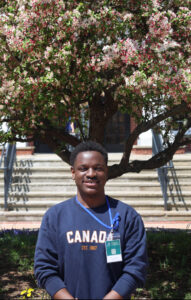
 Adriel Uangbaoje, a third-year Business Major at St. Francis Xavier University, is a summer intern for Coady Institute’s communications team. An international student from Nigeria, Adriel participated in Coady’s Community Peacebuilding Workshop, he shares about his experience below.
There is something about handing over a half-finished painting to someone else that feels like surrender, not of defeat, but of trust. That was the second day of the workshop: each of us had two minutes with a brush before passing our canvas to the person beside us, inviting them to continue the story. We did not know where it would go. We just knew it did not belong to us alone.
This act of collaborative painting mirrored the heart of the Community Peacebuilding Workshop, held in Antigonish June 7 to 9. Over three days, locals from across Nova Scotia gathered to ask urgent questions about peace, conflict, and the meaning of community: not in theory, but in deeply personal, lived terms
Friday began with a question: Who is your community? Through a layered exercise titled “Defining Community”, each participant mapped their identity onto a paper canvas. For me, it was the Pan-African community, rooted in the complexities of Nigeria, a nation both proud and disillusioned. We explored the glue behind our communities: the values, stories, and tensions that hold them together and sometimes pull them apart.
“What makes a community a community?” That was the real question we pondered on throughout the exercise.
Saturday’s theme was peace, explored with complexity. Using the Peace and Conflict Impact Assessment (PCIA) framework, we examined how power, relationships, and structures shape peacebuilding in real life. What does peace mean when your community carries intergenerational trauma? What does it mean when your privilege puts you in rooms others cannot enter?
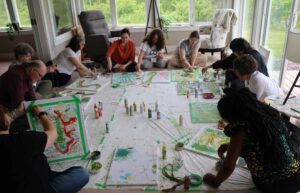
We explored tools for imagining peace, including the “Piece by Peace” painting activity. Each canvas became a metaphor for collaboration and letting go of control. Peace, we learned, is not always symmetrical. Sometimes it is about joining something you did not start, and knowing when to step back.
By Sunday, the language had shifted. Words like resilience, measurement, and community assets came alive not on the slides but in the people beside us. We spoke of governors and journalists, women’s collectives and spiritual leaders, all of whom were part of what The Little Book of Strategic Peacebuilding calls “a group of people affected by violence in their community who come together to plan their response.”
Now, a month later, I still carry what I learned with me, especially as a Nigerian student navigating both home and campus life. I think of the workshop whenever I consider the tensions between communities in Nigeria or when I listen to debates about race and belonging here at StFX. I am learning that peacebuilding is not just for large-scale conflicts; it is needed in residence halls, student unions, and friendships. It is needed wherever people are trying to live together with dignity. So, although the workshop gave me language, it also gave me tools, and a deeper sense of responsibility for the communities I’m part of, both visible and invisible.
Peacebuilding, we learned, is slow and messy. Although it asks more of you than just presence, it also asks for imagination, patience, and the willingness to pass the brush.